Birds in Backyards

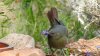
Gang-Gang Cockatoo, male. Photographed in Adelaide backyard for Birds in Backyards. Gang-Gang Cockatoo, male. Photographed in Adelaide backyard for Birds in Backyards.
© C and S Latham

Gang-Gang Cockatoo, male. Gang-Gang Cockatoo, male.
Photo: K Vang and W Dabrowka © Bird Explorers

Distribution map of Callocephalon fimbriatum Distribution map of Callocephalon fimbriatum
Map © Birds Australia Birdata

Did you know?

Gang-gang Cockatoos almost always use their left foot to hold food when eating.

Facts and figures

Research Species: No
Minimum size: 34 cm
Maximum size: 35 cm
Average size: 34 cm
Average weight: 257 g
Breeding season: October to January
Clutch size: Usually two, sometimes one or three.
Incubation: 30 days
Time in nest: 56 days

Calls

Creaky, rising screech that sounds like a rusty hinge: 'ky-or-ark'. A soft growling is made when feeding.

Call in MP3 format (241kb)
Copyright © Fred Van Gessel

Conservation status

Federal - Secure
NSW - Vulnerable

Status of Australian Birds

Gang-gang Cockatoo

Scientific name: Callocephalon fimbriatum
Family: Cacatuidae
Order: Psittaciformes

Featured Bird Groups
Parrots

What does it look like?

Description

The Gang-gang Cockatoo, or Gang Gang for short, is a small, stocky cockatoo with a wispy crest, large, broad wings and a short tail. The adult male has a distinctive scarlet red head and crest, with the rest of the body slate-grey. The adult female has a dark grey head and crest, with the feathers of the underparts edged pink and yellow. In both sexes, the feathers of the upperparts and wings are faintly edged pale-grey, giving a barred appearance, with females having additional yellow edging to their feathers that increases this barred effect. Young birds are similar to the adult female, with young males differing by having a red crown and forehead and a shorter, less twisted red crest. Gang-gangs are gregarious but relatively quiet cockatoos, and may usually be located in food trees by the sounds of feeding and falling debris.

Similar species

The Gang-gang Cockatoo is generally unmistakable, but in flight may resemble a Galah in shape.

Where does it live?

Distribution

Gang-gang Cockatoos are endemic to south-eastern Australia. They are widespread in eastern New South Wales from the central slopes and tablelands to the south coast, down through Victoria's north-eastern regions to Seymour, with some records in east Melbourne, Mornington Peninsula and south-western Gippsland. A disjunct (cut off) population is found in the western half of Victoria from the Otway region to the South Australian border. Formerly found on King Island until the mid-1960s but now considered extinct on the island. Has also been introduced to Kangaroo Island in South Australia.

Habitat

During summer, the Gang-gang Cockatoo is found in tall mountain forests and woodlands, with dense shrubby understoreys. In winter, Gang-gangs will move to lower altitudes into drier, more open forests and woodlands. At this time, they may be seen by roadsides and in parks and gardens of urban areas. They require tall trees for nest hollows.

Seasonal movements

They undergo seasonal altitudinal migration from high forests to lower areas during winter.

What does it do?

Feeding

Gang-gang Cockatoos feed mainly on seeds of native and introduced trees and shrubs, with a preference for eucalypts, wattles and introduced hawthorns. They will also eat berries, fruits, nuts and insects and their larvae. They are mainly arboreal (found in trees), coming to the ground only to drink and to forage among fallen fruits or pine cones. Gang-gangs feed in flocks of up to 60 birds outside the breeding season; they feed in pairs or small family groups during the breeding season.

Breeding

Gang-gang Cockatoos form close, monogamous pairs. The female chooses a nest hollow in a suitable tree and both sexes prepare the nest for egg-laying, lining it with wood-chips and dust by chewing at the sides of the hollow. Both sexes incubate the eggs and care for the young. Parents feed their young for a further four to six weeks after fledging and family groups will be seen feeding together during the breeding season. In some cases, 'crèches' will be formed - where several pairs have nested close together, their young will roost together in the same tree while their parents are foraging.

Living with us

Living with humans

Gang-gang Cockatoos are adversely affected by land clearing and the removal of mature trees (potential breeding hollow sites). One population is listed as threatened: in the Lane Cove Valley, New South Wales.

Urban habitat requirements

Gang-gang Cockatoos require tall trees for nest hollows. They are able to use exotic plants as food in urban areas.

References

Higgins, P.J. (ed) 1999. Handbook of Australian, New Zealand and Antarctic Birds, Volume 4 (Parrots to Dollarbird). Oxford University Press, Melbourne.

Morcombe, M. 2000. Field guide to Australian Birds. Steve Parish Publishing.

Simpson, K and Day, N. 1999. Field guide to the birds of Australia, 6th Edition. Penguin Books, Australia.

Members