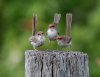
Brown Thornbill.
Photo: SG Lane Collection © Australian Museum
Brown Thornbill.
Photo: K Vang and W Dabrowka / Bird Explorers © K Vang and W Dabrowka / Bird Explorers
Distribution map of Acanthiza pusilla
Map © Birds Australia Birdata
Brown Thornbill
Scientific name: Acanthiza pusilla
Family: Pardalotidae
Order: Passeriformes
- Featured Bird Groups
- Small insect-eating birds
What does it look like?
Description
The Brown Thornbill is a small bird, but is one of the medium-sized and more common of the thornbills. It has olive-brown to grey upperparts, with a warm reddish-brown forehead scalloped with paler markings. The rump has a reddish-brown patch, the tail is grey-brown with a black band and a pale tip, and the underparts are off-white, streaked blackish on the chin, throat and chest. The eye is dark red. The sexes are similar and young birds are only slightly different to adults, with a duller eye.
Similar species
The Brown Thornbill can be confused with other thornbills, including the very similar Inland, A. apicalis, and Tasmanian, A. ewingii, Thornbills, but has shorter tail and less streaking on breast than the former and found in different habitats to the latter. Calls can be similar to the White-browed Scrubwren, Sericornis frontalis, and the Tasmanian Scrubwren, S. humilis.
Where does it live?
Distribution
The Brown Thornbill is found only in eastern and south-eastern Australia, including Tasmania. There is a large overlap with the range of the very similar Inland Thornbill along slopes of Great Dividing Range from Queensland to Victoria. It is widespread in its range from south-eastern Queensland to the Mt Lofty Ranges, South Australia, and throughout Tasmania, excepting the south-west.
Habitat
The Brown Thornbill is found in dense shrubby habitats including wet and dry forests, woodlands, shrublands, heathlands and rainforests, as well as along watercourses, mainly in the temperate and sub-tropical zones. They are found from the coast up to 1200 m. They are found regularly in parks and gardens, especially close to large patches of remnant vegetation and along nature strips in towns and suburbs.
Seasonal movements
Sedentary.
What does it do?
Feeding
The Brown Thornbill feeds mainly on insects, but may sometimes eat seeds, nectar or fruit. They feed, mainly in pairs, at all levels from the ground up, but mostly in understorey shrubs and low trees. Will feed in mixed flocks with other thornbills out of breeding season.
Breeding
Breeding pairs of Brown Thornbills hold territories all year round for feeding and breeding purposes, and the bonds between pairs are long-lasting. Females build a small oval, domed nest with a partially hooded entrance near the top out of grasses, bark and other materials, lining it with feathers, fur or soft plant down. The nest is usually low down, in low, prickly bushes, grass clumps, or ferns. The female incubates the eggs and both parents feed the young, who stay with the parents until early autumn, before being driven out of the parental territory.
Living with us
Living with humans
The Brown Thornbill is adversely affected by fires that reduce understorey, but may benefit from any clearing activity that increases shrubby vegetation cover. They are sometimes caught by cats.
References
Serventy, V.N. (ed) 1982. The Wrens and Warblers of Australia. Angus and Robertson and the Australian Photographic Index of Australian Wildlife, Sydney.
Morcombe, M. 2000. Field guide to Australian Birds. Steve Parish Publishing.
Higgins, P.J. and J.M. Peter (eds) 2002. Handbook of Australian, New Zealand and Antarctic Birds, Volume 6: Pardalotes to Shrike-thrushes. Oxford University Press, Melbourne.