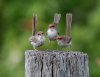
Diamond Firetail.
Photo: K Vang and W Dabrowka © Bird Explorers
Diamond Firetail at nest.
Photo: Purnell Collection © Australian Museum
Distribution map of Stagonopleura guttata
Map © Birds Australia Birdata
Diamond Firetail
Scientific name: Stagonopleura guttata
Family: Passeridae
Order: Passeriformes
What does it look like?
Description
The Diamond Firetail is a small bird sometimes described as one of the most stunningly coloured birds of the finch family. The top of its body is ash brown with crown, forehead and neck grey. The under feathers are white with a crimson rump. There is a black band across its neck which continues down the flank to be dotted with white. The bill and eye ring are coral, and the legs and feet are dark grey. The female is similar to the male although sometimes smaller. The juvenile Diamond Firetail has a black bill and is duller in colour. They fly low and flocks travel in long lines. This species may also be called the Diamond Finch or Java Sparrow.
Similar species
The Diamond Firetail is very distinctive, being larger and more heavily built than the Red-browed Finch, Neochmia temporalis, and slightly smaller and shorter-tailed than the much duller House Sparrow, Passer domesticus.
Where does it live?
Distribution
The Diamond Firetail is endemic to south-eastern Australia, ranging from Carnarvon Ranges in Queensland to the Eyre Peninsula and Kangaroo Island in South Australia.Habitat
Diamond Firetails are found in open grassy woodland, heath and farmland or grassland with scattered trees.
Seasonal movements
Mostly resident or sedentary with some local movements.What does it do?
Feeding
Diamond Firetails feed on the ground and generally eat ripe or partially ripe seeds and can be seen hopping around on the ground. They occasionally eat insects and their larvae.Breeding
The Diamond Firetail builds a nest with green grass blades and stems and lines it with fine grasses and feathers. The nest can be found in trees and shrubs with dense foliage and has sometimes been known to build in the base of a hawk's nest. The nest is built by both partners but only the female does the weaving. Both partners incubate the eggs and care for the young. Usually only one clutch is laid per season.
Living with us
Living with humans
Diamond Firetails have been adversely affected by clearing for agriculture or urban development as well as predation of eggs and nestlings by increased populations of native predators such as the Pied Currawong. They are listed as Vulnerable in New South Wales.References
Higgins, P.J., Peter, J.M. and Cowling, S.J. (eds) 2006. Handbook of Australian, New Zealand and Antarctic Birds, Volume 7 (Dunnock to Starlings) Part B Oxford University Press. Melbourne.