Common Blackbird in a tree.
Photo: K Vang and W Dabrowka / Bird Explorers © K Vang and W Dabrowka / Bird Explorers
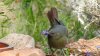
Common Blackbird, male.
Photo: Purnell Collection © Australian Museum
Common Blackbird, female.
Photo: Purnell Collection © Australian Museum
Distribution map of Turdus merula
Map © Birds Australia Birdata
Common Blackbird
Scientific name: Turdus merula
Family: Muscicapidae
Order: Passeriformes
- Featured Bird Groups
- Birds behaving badly
- Top 40 bird songs
- Introduced birds
What does it look like?
Description
The Common Blackbird was introduced to Australia at Melbourne in the 1850s. The male is the 'black' bird, with deep orange to yellow bill, a narrow yellow eye-ring and dark legs. The female is a brown bird, with some streaks or mottling, and has a dark bill and legs. Immature birds are similar to the female with lighter underparts.
Similar species
The Common Blackbird is not readily confused with other 'black' birds as it is much smaller than most Australian birds with a similar colouring and has a distinctive yellow eye-ring.
Where does it live?
Distribution
The Common Blackbird, was originally confined to Melbourne and Adelaide, but has gradually expanded its range throughout south-eastern Australia, both on the coast and inland, as far north as Sydney, and including Tasmania and the Bass Strait islands.
Habitat
The Common Blackbird is most often found in urban areas and surrounding localities, but has successfully moved into bushland habitats. It is often seen in orchards, vineyards and gardens, as well as along roadsides and in parks.
What does it do?
Feeding
The Common Blackbird eats insects, earthworms, snails, spiders and a range of seeds and fruit. It mainly forages on the ground, probing and scratching at leaf litter, lawns and soil.
Breeding
The Common Blackbird builds a cup-shaped nest of dried grass, bound with mud, and lined with fine grasses. It is usually placed in a tree, shrub or low bush, but they will also use tree hollows.
Living with us
Living with humans
The Common Blackbird can be a pest in orchards, parks and gardens, being rather destructive of ground vegetation, particularly backyard vegetable patches.
References
Schodde, R. and Tideman, S.C. (eds) 1990. Reader's Digest Complete Book of Australian Birds (2nd Edition). Reader's Digest (Australia) Pty Ltd, Sydney.
Morcombe, M. 2000. Field guide to Australian Birds. Steve Parish Publishing.