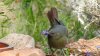
Spiny-cheeked Honeyeater.
Photo: K Vang and W Dabrowka © Bird Explorers
Distribution map of Acanthagenys rufogularis
Map © Birds Australia Birdata
Spiny-cheeked Honeyeater
Scientific name: Acanthagenys rufogularis
Family: Meliphagidae
Order: Passeriformes
- Featured Bird Groups
- Honeyeaters
What does it look like?
Description
The medium-sized Spiny-cheeked Honeyeater has a grey crown scalloped brown, a mottled grey-brown back, a white cheek with spiny bristles to below the ear, and an orange-brown throat and chest. The underparts are white, streaked brown, the wings are grey, with white-edged feathers, and the long tail is dark grey-brown with white tips. The pale blue-grey eye is surrounded by bare pinkish skin and the pink bill has a black tip. Young birds are browner and have yellow cheek spines. Spiny-cheeked Honeyeaters are sociable and aggressive, and are often seen or heard in large flocks, foraging high in trees.
Similar species
The Spiny-cheeked Honeyeater looks like a small wattlebird, but has a distinctive orange chest and throat, white cheek spines and a bicoloured (pink and black) bill.
Where does it live?
Distribution
The Spiny-cheeked Honeyeater is found across mainland Australia, especially in the arid interior, reaching the coast from Esperance, Western Australia to Melbourne, Victoria. It is also found on Kangaroo Island. It is absent from the east coast, and is not found in the northern tropics from the Kimberley region, Western Australia to Cape York, Queensland.
Habitat
The Spiny-cheeked Honeyeater is found in dry woodlands, mallee and acacia scrub, especially with a porcupine grass understorey. Also found in coastal scrubs, woodlands along rivers and, occasionally, mangroves. May be found in orchards.
Seasonal movements
Sedentary in the south of its range, partially migratory in the north.
What does it do?
Feeding
The Spiny-cheeked Honeyeater feeds mainly on nectar and fruit, but may also eat insects, reptiles and baby birds. It forages in the dense foliage and outer branches of trees, but may sometimes feed on the ground or take insects in the air.
Breeding
The Spiny-cheeked Honeyeater builds a deep, suspended, cup-shaped nest of plant fibres and grasses bound with spider webs and lined with soft materials, which is placed from 1 m to 13 m from the ground. The female incubates the eggs alone, but both sexes feed and care for the young.
References
Longmore, N.W. 1991. The Honeyeaters and their Allies of Australia. Angus and Robertson and The National Photographic Index of Australian Wildlife, Sydney.
Simpson, K and Day, N. 1999. Field guide to the birds of Australia, 6th Edition. Penguin Books, Australia.