Birds in Backyards

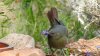
Grey Butcherbird. Grey Butcherbird.
Photo: K Vang and W Dabrowka © Bird Explorers

Grey Butcherbird. Grey Butcherbird.
Photo: K Vang and W Dabrowka © Bird Explorers

Grey Butcherbird, silhouette. Grey Butcherbird, silhouette.
Photo: K Vang and W Dabrowka / Bird Explorers © K Vang and W Dabrowka / Bird Explorers

Distribution map of Cracticus torquatus Distribution map of Cracticus torquatus
Map © Birds Australia Birdata

Did you know?

Butcherbirds get their name from their habit of hanging captured prey on a hook or in a tree fork, or crevice. This 'larder' is used to support the victim while it is being eaten, to store several victims or to attract mates.

Facts and figures

Research Species: Yes
Minimum size: 24 cm
Maximum size: 30 cm
Average size: 27 cm
Average weight: 100 g
Breeding season: July to January
Clutch size: 3 to 5
Incubation: 25 days
Time in nest: 28 days

Calls

The song is a lovely rich piping with some mimicry and harsher notes.

Call in MP3 format (313kb)
Copyright © Fred Van Gessel

Conservation status

Federal - Secure
NSW -

Status of Australian Birds

Grey Butcherbird

Scientific name: Cracticus torquatus
Family: Artamidae
Order: Passeriformes

Featured Bird Groups
Survey species
Top 40 bird songs

What does it look like?

Description

The adult Grey Butcherbird has a black crown and face and a grey back, with a thin white collar. The wings are grey, with large areas of white and the underparts are white. The grey and black bill is large, with a small hook at the tip of the upper bill. The eye is dark brown and the legs and feet are dark grey. Both sexes are similar in plumage, but the females are slightly smaller than the males. Young Grey Butcherbirds resemble adults, but have black areas replaced with olive-brown and a buff wash on the white areas. The bill is completely dark grey and often lacks an obvious hook. They are sometimes mistaken for small kingfishers.

Similar species

The Black Butcherbird, Cracticus quoyi, from the rainforests and mangroves of the north of Australia is all black, with a blue-grey bill. The widespread Pied Butcherbird, C. nigrogularis, is larger and boldly marked in black and white.

Where does it live?

Distribution

Grey Butcherbirds range from mid-eastern Queensland, through southern Australia, including Tasmania, to northern Western Australia. There is an isolated population in the Kimberley and the northernmost parts of the Northern Territory.

Habitat

Grey Butcherbirds are found in a range of wooded habitats, including suburban areas. In inland areas, the birds tend to favour the denser forests.

What does it do?

Feeding

Grey Butcherbirds are aggressive predators. They prey on small animals, including birds, lizards and insects, as well as some fruits and seeds. Uneaten food may be stored in the fork or a branch or impaled. Grey Butcherbirds sit on an open perch searching for prey which, once sighted, they pounce on. Most mobile prey is caught on the ground, though small birds and insects may be caught in flight. Feeding normally takes place alone, in pairs or in small family groups.

Breeding

The Grey Butcherbird's nest is bowl-shaped, and is made of sticks and twigs, lined with grasses and other soft fibres. It is normally located within 10 m of the ground. The eggs are incubated by the female and the young birds are fed by both parents. The young birds will remain in the breeding territory for about a year, and help the parents raise the young of the following season.

References

Pizzey, G. and Knight, F. 1997. Field Guide to the Birds of Australia. Angus and Robertson, Sydney.

Schodde, R. and Tideman, S.C. (eds) 1990. Reader's Digest Complete Book of Australian Birds (2nd Edition). Reader's Digest (Australia) Pty Ltd, Sydney.

Strahan, R. (ed) 1996. Finches, Bowerbirds and Other Passerines of Australia. Angus and Robertson and the National Photographic Index of Australian Wildlife, Sydney.

Members