Birds in Backyards

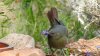
Bassian Thrush. Bassian Thrush.
Photo: K Vang and W Dabrowka © Bird Explorers

Bassian Thrush at nest. Bassian Thrush at nest.
Photo: Purnell Collection © Australian Museum

Distribution map of Zoothera lunulata Distribution map of Zoothera lunulata
Map © Birds Australia Birdata

Did you know?

If a Bassian Thrush is disturbed it often runs a short distance and then freezes, relying for defence on the camouflage of its mottled plumage against the leaf-litter of the forest floor.

Facts and figures

Research Species: No
Minimum size: 27 cm
Maximum size: 29 cm
Average size: 28 cm
Average weight: 100 g
Breeding season: June to February, also recorded in April
Clutch size: Two to three.
Incubation: 14 days
Time in nest: 14 days

Calls

The Bassian Thrush can be heard mainly at dawn or in dull weather, its song being three notes: the first steady, the second rising briefly, and the third steady.

Call in MP3 format (283kb)
Copyright © Fred Van Gessel

Conservation status

Federal - Secure
NSW - Secure

Status of Australian Birds

Bassian Thrush

Scientific name: Zoothera lunulata
Family: Muscicapidae
Order: Passeriformes

What does it look like?

Description

The Bassian Thrush is a secretive bird. Its plumage is mottled brown to olive-brown, heavily scalloped with black crescent-shaped bars on the back, rump and head. The paler underparts all have brown-black scalloping. It has a white eye-ring. In flight the Bassian Thrush shows a broad dark diagonal bar across the white underside of its wing. This species has also been referred to as White's Thrush, Ground Thrush, and Scaly Thrush.

Similar species

The Bassian Thrush is very similar to the Russet-tailed Thrush, Z. heinei. The latter has slightly brighter rufous upper parts. The tail of the Bassian Thrush is slightly longer.

Where does it live?

Distribution

The Bassian Thrush is found predominantly around the south-east of Australia, and also in the Atherton Tablelands, Queensland.

Habitat

Damp, densely forested areas and gullies are favoured by the Bassian Thrush, usually with a thick canopy overhead and leaf-litter below.

Seasonal movements

Resident, probably sedentary.

What does it do?

Feeding

The Bassian Thrush feeds on the ground, scratching under the leaf-litter for small invertebrates.

Breeding
The Bassian Thrush builds a large, deep, cup-shaped nest in a major tree fork or in a depression on top of a stump. The nest may be quite low or up to about 15 m above the ground. Both parents care for the young.

Living with us

Living with humans

The Bassian Thrush is adversely affected by clearing of densely vegetated habitats.

References

Morcombe, M. 2000. Field guide to Australian Birds. Steve Parish Publishing.

Flegg, J. 2002. Birds of Australia: Photographic Field Guide, 2nd Edition. Reed New Holland, Sydney.

Barrett, G., Silcocks, A., Barry, S., Cunningham, R. & Poulter, R. 2003. The New Atlas of Australian Birds. Birds Australia, Hawthorn East, Vic.

Higgins, P.J., Peter, J.M. and Cowling, S.J. (eds) 2006. Handbook of Australian, New Zealand and Antarctic Birds, Volume 7 (Dunnock to Starlings) Part B Oxford University Press. Melbourne.

Members